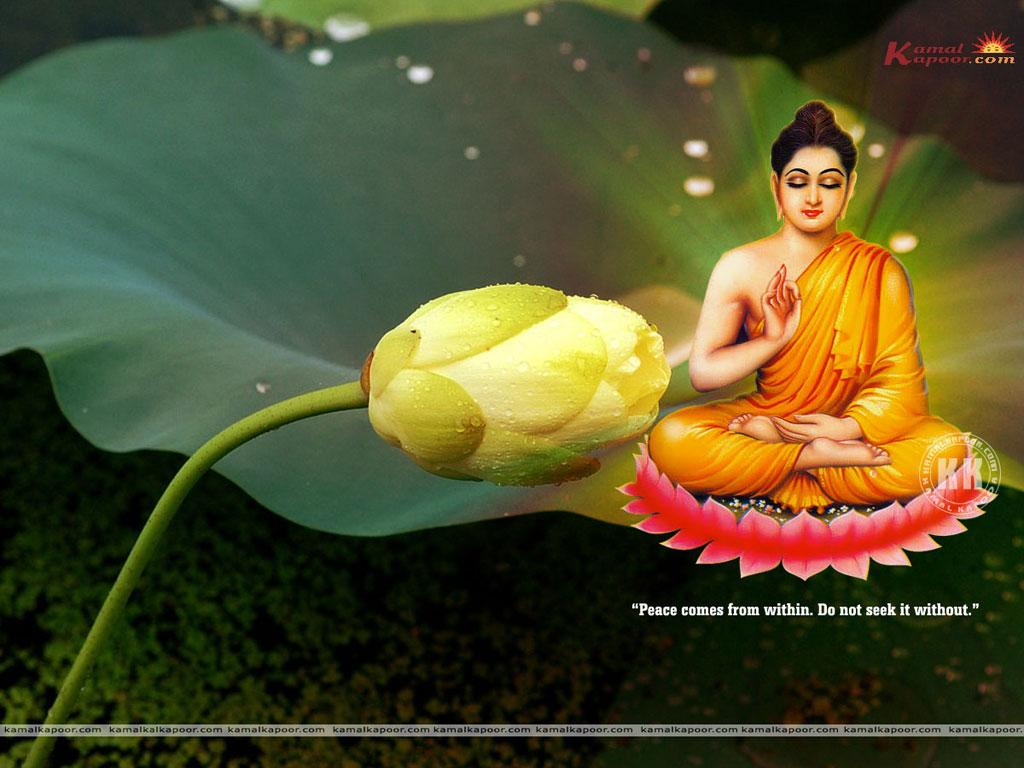
What is Buddhism? Religion without God?
Buddhism is a major world religion with a complex history and philosophy.
It’s founder; Siddhartha Gautama lived from about 566 to about 480
B.C. The son of Indian Warrior- King, Gautama led a life of luxury in
his early years, enjoying the privileges of his caste. But eventually he
tired of the affluence and ease, and set out what some might call a
“vision quest”. After encountering an old man, and ill man, a corpse and
ascetic, Gautama became convinced that suffering lay at the heart of
all existence, stemming principally from the human ego’s attachment to
the transitory things of this world. He renounced his princely title and
became a monk, freeing himself of possessions in the hope of
comprehending the truth, and finding a path toward enlightenment and
liberation. The culmination of his search came while meditating beneath a
tree, where he experienced a breakthrough in understanding. Following
this epiphany, Gautama came to be known as the Buddha, meaning the
“enlightened one”. He spent the remainder of his life journeying about
India, teaching others what he had come to believe.
Basic Belief and practices
The basic doctrines of early Buddhism, which remain common among
Buddhist today, include the “four noble truth”. Existence is suffering
(dukhka); suffering has a cause, namely craving and attachment
(trishna); there is a cessation of suffering, which is Nirvana; and
there is path to the cessation of suffering, the “eightfold path” of
right views, right resolve, right speech, right action, right
livelihood, right effort, right mindfulness and right concentration.
Meditation and observance of moral precept are the foundation of
Buddhist practice. The five basic moral precepts, undertaken by members
of monastic orders and the laity, are to refrain from taking life,
stealing, acting unchastely, speaking falsely, and drinking intoxicants. 
The relationship between Buddhism and Christianity
Note that in this brief description of Buddhism, the word “God” not
appear. Thus when thinking about the relationship between Buddhism and
Christianity or other theistic religions, there tend to be two paths of
inquiry. Taking Buddhism at face value as a system of ethical precepts, a
philosophy of life, and a set of meditative practices, many Christians
and Jews have found it quite possible to affirm major aspects of
Buddhism can be seen as supplement and enriching their own theistic
faith and practice.
For example, Robert Kennedy is a Jesuit priest
and theologian, but also a Buddhist master and leader of a Zendo or
meditation center in New York City. In one of his books, Zen gifts to
Christians, Kennedy reports that many people who are interested in
nurturing their spirituality have found a way forward through the study
and practice of Buddhism. This is not because they wish to become
Buddhists, necessarily, but because they seek a more rewarding
contemplative life.
Buddhist and Christians in conversation
A very different take on the relationship between Buddhism and
Christianity involves emphasizing the point of difference. For example,
Christians tend to emphasize that the soul (and possibly even the body)
survive death through the miracle of resurrection. From a Buddhist
perspective this might seem to be a form of eternal imprisonment within
the limitations of one’s ego. Also Christians tend to believe that Jesus
was and is absolutely unique as the divine son of God, whereas
Buddhists, while venerating the Buddha, do not worship him as God. On
the other hand, Christians tend to see Buddhism, with its renunciation
of the ego, and its emphasis upon the illusory nature of worldly reality
as offering an escape from, rather than a solution to the evils of the
world. On the other hand, there is a plenty of escapism in some forms of
Christian piety while many Buddhists have an impressive track record of
social activism and engagement in the struggle for human justice, The
Dalai Lama being a leading example. Thus there are rich opportunities
for conversations between Buddhist and Christians with much to be
learned on both sides.
Buddhism as defined by widely respected reference works
The teaching of Buddha that life is permeated with suffering caused
by desire, that suffering ceases, and that enlightenment obtained
through right conduct, wisdom, and meditation releases one from desire,
suffering, and rebirth. The religion represented by the many groups,
especially numerous in Asia, that profess varying forms of this doctrine
and that venerate Buddha.
|
|
How to become a Buddhist?
He who has gone for refuge in the Buddha, his teaching and his order, penetrates with transcendental wisdom the four noble truths- suffering, the cause of suffering, the cessation of suffering, and the noble eightfold path leading to the cessation of suffering. This indeed is the safe refuge this is the refuge supreme. Having gone to such a refuge, one is released from all suffering.
- Dhammapada 190-192 –
Many people, after encountering the Dhamma or the Buddhist teachings ask:
How do become a Buddhist?
Once, there was a man called Upali. He was a follower of another religion and he went to the Buddha in order to argue with him and try to convert him. But after talking to the Buddha, he was so impressed that he decided to become a follower of Buddha. The suttas record the Buddha’s reply and Upali’s reaction as follows:
“Make a proper investigation first. Proper investigation is good for a well-known person like yourself”. Now I am even more pleased and satisfied when the Lord says to me: Make a proper investigation first,” For if members of another religion had secured me as a disciple they would have a paraded a banner around the town saying: Upali has joined our religion, but the lord said to me: “Make proper investigation first, proper investigation is good for a well-known person like yourself.”
In the Buddhism, understanding is the most important thing and takes time. So do not impulsively rush into it. Take your time, ask questions, consider carefully, and then make your decision. The Buddha was concerned that people should follow his teaching as a result of understanding a conviction.
I have done this and am convinced of its truth and that it is the path for me.
What do I do become a Buddhist?
A person becomes a Buddhist By taking the refuges that is the Buddha, the Dhamma or his teachings and Sangha or community of enlightened beings.
:To take refuge in the Buddha, Dhamma and Sangha and see with real understanding the four noble truths,- suffering, the cause of suffering, the transcending of suffering and the noble eightfold path that leads to the transcending of suffering, This indeed is a safe refuge , it is the refuge supreme. It is the refuge whereby one is freed from all suffering.
To take refuge, it is best done with the guidance of a monk. However, if such a person is not available, one may take refuge before an image of Buddha. Place this image, which may be a statue, a picture or even a computer graphic such that when you kneel before it. It is at the level of your head or higher. Kneel before the image and put your palms together at your chest. Compose your self, calm your mind and bow three times to the image such that your palms and forehead touches the floor. Then recite the following formula in pali, which is the ancient language of scriptural texts.
Namo tassa, bhagavato, arahato, samma sambuddhasa
Namo tassa, bhagavato, arahato, samma sambuddhasa
Namo tassa, bhagavato, arahato, samma sambuddhasa
Buddhan saranam gacchami
Dhamman saranam gacchami
Sanghan saranam gacchami
Dutiyampi Buddhan saranam gacchami
Dutiyampi Dhamman saranam gacchami
Dutiyampi Sanghan saranam gacchami
Tatiyampi Buddhan saranam gacchami
Tatiyampi Dhamman saranam gacchami
Tatiyampi Sanghan saranam gacchami
This means;
Homage to him, the exalted one, the worthy one, the supremely enlightened one.
Homage to him, the exalted one, the worthy one, the supremely enlightened one.
Homage to him, the exalted one, the worthy one, the supremely enlightened one.
I go to the Buddha as my refuge
I go to the Dhamma as my refuge
I go to the Sangha as my refuge
For the second time, I go to the Buddha as my refuge
For the second time, I go to the Dhamma as my refuge
For the second time, I go to the Sangha as my refuge
For the third time, I go to the Buddha as my refuge
For the third time, I go to the Dhamma as my refuge
For the third time, I go to the Sangha as my refuge
Congratulations!
You are now officially a Buddhist. But wait, the ceremony is not complete. The Buddha recommends that all his disciples keep the minimum of the five precepts. These are not rigid commandments that one is compelled to live by. They really are more like training rules that are taken voluntarily. They establish your virtue and protect you from harm in this life as well as in the future lives. It is the foundation for your spiritual journey.
Yes I would like to take the precepts and live my life accordingly, knowing that it is conductive for my happiness and welfare in this life as well as in the future lives.
How do I take these five precepts?
Again, the five precepts are taken by reciting in Pali while in the kneeling position.
Panatipata veramani sikkhapadan samadiyami
Adinnadana Veramani sikkhapadan samadiyami
Kamesu micchacara veramani sikkhapadan samadiyami
Musavada veramani sikkhapadan samadiyami
Sura meraya majja pama dattana veramani sikkhapadan samadiyami
This means
I undertake the precept of abstaining from destroying living creatures.
I under take the precept of abstaining from taking anything not freely given.
I undertake the precept of abstaining from sexual misconduct.
I undertake the precept of abstaining false speech.
I undertake the precept of abstaining from taking intoxicants which lead to carelessness.
That is it, now you are a practicing Buddhist. The three refuges and five precepts can be repeated any time you wish, either at regular intervals or when you feel the need to do so. Welcome to the path. This is only the beginning and it is suggested that you join a Buddhist community to support it and be supported by it, and to continue to learn the Buddha’s teachings.
|
